Friday, June 30, 2006

mtDNA in the Berry Family Project

Since some of us may also be interested in finding our matrilineal ancestors we also have mtDNA pages for results and specifics on the Berry Family DNA Project website.

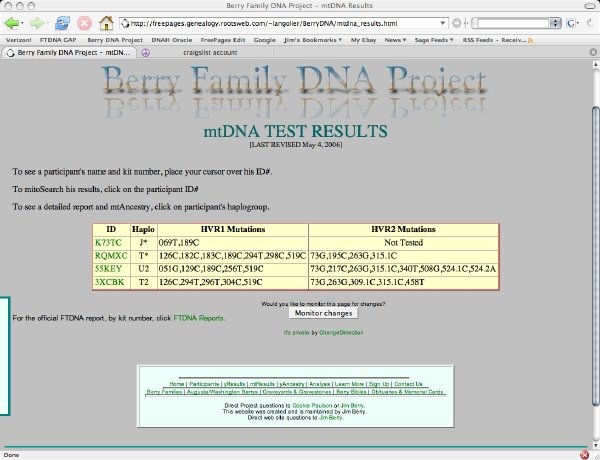
The results page, shown below, is called mtDNA Test Results and displays your mitosearch ID (it's the same as your ySearch ID), your haplogroup, and your HVR 1 and HVR 2 mutations.   Hovering your cursor over the mitosearch ID will display that person's name and kit number, clicking on it will open the searchable mitosearch site.
Click picture to magnify image
Link to mtResults page

Clicking on the haplogroup number on the mtDNA Test Results page will open the personal mt results page for that person on which the specific mutations are displayed, and with the option to display a descendant report showing the relationship of all those persons having your same mtDNA sequence.   An example of this page is shown below (pretend there's no break between the upper and lower parts.   I didn't know how to join them.)
Click picture to magnify image
Link to personal results page

If you've had an mtDNA test at FTDNA, no problem, I can get the results directly.   If you've had your mtDNA test anywhere else, we'd still like you to join us;  I'll just need more help from you to gather the information.

Thursday, June 29, 2006

Slow day

Not much seems to be going on on the DNA front.   Nothing much new on the discussion boards.   Everyone seems to be waiting for either results from their Deep SNP tests or from their 67 marker upgrades or for those that have their results, for the online tools to be upgraded to accept those new markers to begin doing some comparisons and analyses.   FTDNA has told their customers that they're having unexpected validation problems with their Deep SNP tests, that they'll post partial results where they have them but don't expect full results until the beginning of August.   No word on the ySearch or Family Tree DNA Time Predictor upgrades.

We did get our 73rd member today.   Karen Berry Lewander ordered the 67 marker test for her father.   Edward Jay Berry will be Participant #71 and seems to have ancestors among the Madison Co. (Virginia) Berrys.   His results will be interesting.

We might also have another participant.   Karen tells me she took advantage of the recent Argus BioSciences mtDNA promotion so if she chooses to post her results to the Project when she gets them, add one more (remember, we count mtDNA participants separately).

I'd be interested to hear from anyone else who ordered the Argus BioSciences mtDNA promotion.   Although their special Hypervariable Region Promotion has now concluded, their 'regular special' price for this test has been reduced to $75.   This is the same mtDNA test that sells for $159 elsewhere.

Wednesday, June 28, 2006

mtDNA 201

In connection with the amazing offer by Argus BioSciences, see mtDNA News Flash!!, it has been suggested that I write a short article on mitochondrial DNA and what it can tell you.   You will recall that I've already done an article called mtDNA 101 and I thought that I probably could do no better this time than to quote a short article by Bryan Sykes, Professor of Human Genetics at the Weatherall Institute of Molecular Medicine, University of Oxford, written October 9, 2003, entitled Mitochondrial DNA and human history, so, here it is:
Human genetics got a real boost with the discovery that mitochondria have their own DNA.   Mitochondria are tiny organelles that live in the cytoplasm of cells, the fluid-filled space between the cell nucleus and the outer membrane.   There are thousands of mitochondria in each cell, and each one has its own small circle of DNA, a reminder of their distant bacterial ancestry.

What makes mitochondrial DNA (or mDNA for short) so special and so useful?   First is its unique inheritance pattern.   Human eggs are full of mitochondria, while sperm have only a hundred or so, just enough to power it while it swims towards the egg.   After fertilisation, when the sperm penetrates the egg, these few male mitochondria are immediately destroyed.   This means that, while we all receive our nuclear DNA, with the exception of the X and Y sex chromosomes, from both parents, we get all of our mDNA from our mothers.   She got it from her mother, who got it from hers – and so on back in time.

Mitochondrial DNA is most useful in connecting the maternal lines of living people in different parts of the world.

The other handy thing about mDNA is that it changes much more rapidly than nuclear DNA, about 20 times as fast, because mitochondria lack an efficient proof-reading system to check for errors when DNA is copied.   The high mutation rate means that there is plenty of variation in the sequence of mDNA between people, and variation is the lifeblood of genetics.

For geneticists and historians, mDNA is a natural for tracing maternal genealogies but the real excitement is in tracing much deeper connections.   It is so abundant in cells that traces can still be found in human remains many thousands of years old, like Oetzi the Iceman.   In 1994 my research team showed that Oetzi had exactly the same mDNA as many people alive today.   Its retrieval from ancient bone has been instrumental in many famous cases of historic significance, such as confirming the identity of the remains of the last Tsar and his family.

But I think mDNA is most useful in connecting the maternal lines of living people in different parts of the world, and here it has been used to solve many oustanding riddles.   For example, we used mDNA to show that all Polynesians could traced their ancestry back to southeast Asia and not to the Americas, as the late Thor Heyerdahl famously claimed.   Others have used mDNA to prove that the ancestors of native Americans really did cross from Siberia about 13,000 years ago, putting an end to such unlikely claims as they were the descended from a lost tribe from the Middle East.

Tracing the early history of the human colonisation of Europe beginning about 45,000 years ago has been another success story for mDNA, proving that most Europeans trace their ancestry to hunter-gatherers who arrived during the last Ice Age, rather than farmers coming from the Middle East.   And also that the Neanderthals have left no trace in the European gene pool and almost certainly became extinct.

Among native Europeans, almost everybody can trace their maternal genealogy, using mDNA, to one of only seven women, their ancient clan mother.   To give them an identity I have given these women names:  Ursula, Xenia, Helena, Velda, Tara, Katrine and Jasmine.   The women lived between 10,000 and 45,000 years ago, six of the seven were hunter-gatherers, the seventh, Jasmine, was an early farmer.   These seven women are also related to each other, and these connections can also be followed by mDNA.   They join up with the clan mothers from other parts of the world and ultimately coalesce in one woman – mitochondrial Eve, who lived in Africa about 150,000 years ago.   Wherever we live on the planet, we are all her descendants.
I don't know how many of the 25 Argus BioSciences offers may be left.   Don't be left out.

Monday, June 26, 2006

mtDNA News Flash!!

I've mentioned Argus BioSciences before.   I just visited their site again and discovered that they now have a Special Limited Time Promotion going.   HVR I & II for $25 for the first five (5) customers that send an email to info@argusbio.com.

6/27/06 - Offer now extended to first 25 customers.   This is a good deal!

This is a significant test that includes base pairs 16000 to 16569 and 00001 to 00575, for a total of 1145 base pairs.   This region contains the mitochondrial D-loop, including hypervariable regions HVR1 and HVR2.   It usually costs $149 and has been on sale at Argus for $99.

I talked about mtDNA before, also.   If you are interested in your mtDNA this is a once-in-a-lifetime opportunity, in my opinion.

As an illustration of what a 'stand up' outfit Argus BioSciences is;  I emailed in response to the offer even though I'd already ordered mine a month ago, supposing that I was not eligible.   Much to my surprise I received a reply from David Whyte, PhD, founder of the Company, offering me a refund of the difference off my original purchase.   They certainly didn't have to do that.

What this means to you, though, is that there are only four (4) or less opportunities left.   Act Now!

Deep Clade Haplogroup Testing

Yesterday I reported that Brian, #49, and Keith, #54, were still awaiting results on their overdue R1b DeepSNP tests.   Today I read on one of the lists that some folks have partial results posted even though FTDNA has not sent them an email notification.   Evidently you only get the notification when the test is complete.   Both of our guys do have partial results with this caveat:
Your haplogroup assignment represents a partial result from your Deep Clade test.   One or more SNP tests failed to produce a clear result.   These SNPs are being rerun.   However all the SNPs that provided a result through the testing are displayed so that you can see what you are (+) and which SNPs you can rule out (-) at this time.
Both Brian and Keith are haplogroup R1b1c and have these partial results:
Brian  -  M173+ M207+ M269+ M343+ P25+ SRY10831.2+ 
M124- M126- M153- M157- M18- M198- M222- M56- M65- M73- M87- SRY2627-
Keith - M173+ M207+ M269+ M343+ P25+
M126- M153- M18- M222- M65- M73- SRY2627-
According to FTDNA, "[t]he value of a Deep Clade Panel test is to identify your twig of the Y DNA tree, and then to use this information to consult the scientific literature to determine the geographic locations identified for your twig.   As research progresses, more geographical specificity associated with SNPs will emerge."

For those interested in pursuing this subject further, here are a couple of links:
  • Deep Clade Testing
  • Y-DNA Haplogroup Tree
  • Sunday, June 25, 2006

    Sunday

    Not much to report for having been gone for better than a week.   Brian, #49, has finally received his 67 marker results and they are posted.   He's still waiting for his DeepSNP-R1b as is Keith, #54.   Brent, #4 is refining his YDNA from 25 to 37 markers and we have a new transfer from the Genographic Project, Charles, #70, whose YDNA-12 results are posted but, unfortunately, don't match anyone.   Charles is our 72nd member.

    The Augusta/Washington Berrys seem to be still waiting to see how helpful the 67 marker results appear to be before jumping in.   In addition, I suppose, to letting the dust settle and the kinks be worked out of FTDNA's testing for this new panel.   There's been little discussion on the boards of the results that have been delivered.   The primary discussion seems to be complaining about the time it has taken to get results and the failure to keep customers updated on the reasons therefor.

    Oh, and I misspelled 'grisly'.   Used too many e's.

    Thursday, June 15, 2006

    * * * HIATUS * * *

    Sorry, but this is going to be a long one.   We leave about noon today for the West Virginia State Folk Festival in Glenville, WV, one of the oldest continuing folk festivals in the country.   The thing I like about it is that it's really small-town.   It's mainly old time music contests, contras and squares and jamming in the motel parking lot, but they do have a parade (no bands) and I plan to enter the spelling bee.   It's so small-town that the local restaurant doesn't even raise the prices on their offerings.   . . . and they do have elephant ears!  (not at the restaurant, at the festival).   Not those crummy funnel cakes, real elephant ears!  (fried dough to the uninitiated).

    We'll be there until Sunday when we drive on down to Marlinton, WV, for a week of music workshops at Allegheny Echoes.   Betty will be taking dulcimer and I'll be taking clawhammer banjo.   We've been going to these things so long that these are all our people and it's like a big family homecoming when we get there.   We'll return home then sometime Saturday, the 24th.

    A couple of DNA newsy bits:  We got our 70th member yesterday when Michael Dwain Berry ordered his Y-DNA37 test; and our 71st member early this morning, Michael J. Beery, Y-DNA12; Another batch of 67 marker upgrades arrived last night but still not Brian's.   It'll probably show up while I'm gone.

    So, in the meantime, click here to Think Peace!

    Wednesday, June 14, 2006

    Setup Preferences

    Continuing my review of the Berry Family Project at FTDNA, I've noticed that several of our members have their 'Setup Preferences' page set to "restrict the display of matches only to my Surname Project" instead of "I want my matches to be set against the entire database."

    In my opinion, this is a mistake.   For example, had Cameron, #58, a Canadian member of the Genographic Project and Jim, #7, not had our preferences set to the more expansive choice, I never would have seen him as a match who was not in the Project.   As a result of seeing that match and inviting him to join the Project I also discovered Patrick, #60, a probable match to the Augusta/Washington Berrys from Australia.   The ancestors of both Cameron and Patrick emigrated to their respective countries directly from Ireland, thus now giving the U.S. branch of the family a backdoor to trying to locate our U.S. immigrants' families in Ireland.

    Please review your own setting of this important choice.   If you have difficulty figuring out how to do this and want me to set it for you, either way, just let me know and I'll be happy to assist.

    Tuesday, June 13, 2006

    Interesting Conjectures

    I was just looking at the various Berry 'families' that have shown up so far in our testing.   We have (maybe) eight and they can be seen here at the FTDNA Berry website.   My reason for looking was to see if I could estimate what additional testing and by which members would best advance the knowledge base for that family.   As you can see from the table, various of the 'families' have varying numbers of markers tested by their members.   Once we get all in a family to the same level a cladogram can be run for that whole group.   The higher that level is, the more interesting and informative that cladogram will be.

    Probably the most interesting of the 'families' is the five member 'Culpeper Co. (aqua) Berry' family, two of whom I can only classify as 'possible' because they have only tested 12 markers.   I say they are probably the most interesting simply because none of the group are able to trace their male line back to a common ancestor with any of the others.   If the two 12 marker members brought their markers up to 25 they could determine 'relatedness'.   If all brought their markers up to 37 or 67 I would expect some very interesting results from a cladogram but I must confess, it's such a new tool that I couldn't guess what those interesting results might be.
    News Flash!   Harold's (#62) 37 marker results just finished coming in.   Now there's only one 'possible', and his upgrade to 37 markers is awaiting shipment to the lab!

    Another interesting group, although small, is the 'possibly' related two member 'English' (lt. blue) Berry family.   Interesting because one of them is from England and one from Canada.   They should each bring their markers up to 25 to verify 'relatedness' but until additional members show up I'm not sure how much value additional markers might be.

    The same observation could be made for the other two member family, the 'Spartanburg Co., SC (green) Berry family.   I have them marked as 'verified' although that really should only be a 'possible' since one of them has only tested 12 markers and they have no paper trail connection.   His should be brought up to 25 to confirm relatedness, or more awaiting additional members.

    Except for finding the connection for #21, the Berry Plain (blue) Berrys can probably only benefit from additional markers by comparing 67 marker cladograms to see what discrimination there may be between the lines.

    We've already seen a 37 marker cladogram for four of the five members of the Orange Co., NC (red) Berry family.   That was already showing some interesting distinctions.   Get all those folks up to 67 markers (including #44) and we might learn something about differences between lines where the common ancestor is only five to seven generations back.

    Four of the seven members of the Benton Co. (gold) Berrys have tested to 37 markers, the rest 25.   Problem is that these four are so closely related (father, 2 sons and a grandfather) as to essentially be one for comparison purposes.   Again, all have paper trails back to a common ancestor varying from five to seven generations in length.   It might take 67 markers here, also, to show anything really interesting.

    Of the 13 members of the Augusta/Washington (purple) Berrys, seven have tested to 37 markers, four to 25 markers and one to 12.   The 37 marker cladograms [Augusta/Washington County Berrys Relationships] were interesting enough that several have expressed an intention to go to 67 markers once there is some indication that these additional markers do indeed add the discrimination to the haplotype that one would expect they should.   Just bringing the other five members to 37 markers would be an interesting giant step in itself.

    Last, but not least, are the three members of the Faires (fuscia) Berrys who, in addition to the interrelationships between their own lines, have a connection to the Augusta/Washington Berrys.   The daughter of a 'Faires Berry', Lucinda, married John D. Berry, of the Hawkins Co. branch of the Augusta/Washington Berrys.   Two of the members of this family have tested to 25 markers, and one 'possible' to 12.   Since the yAncestry for the 'possible' extends back 50 years beyond the other two, refining all these tests to 37 markers, or perhaps even 67, could help unravel these relationships.
    Sunday, June 11, 2006

    FTDNA 67 Marker Results

    The new 67 marker results from FTDNA have started to arrive.   These new markers have been long delayed beyond their expected arrival, probably at least in part, due to difficulties of scale.   Adding 30 new markers in one fell swoop is not a trivial undertaking.

    What does this mean to the Berry Family DNA Project?   Unfortunately, not much.   Only one of our group, Brian, #49, had sufficient of the exploring spirit to jump right in.   His markers have not yet arrived but should shortly as he was in one of the earlier batches.

    Several of the Augusta/Washington Berrys have indicated that they also intend to refine to 67 markers once they've had an opportunity to see that the additional markers do, in fact, add value to the haplotype.   Hopefully, others will follow suit.

    I believe that these will become very interesting once sufficient persons from any given 'family' have tested to 67 markers for a cladogram to be generated showing (hopefully) the various lines of the family and the degrees of 'relatedness' between them.

    On my recent bluegrass sojourn I had occasion to be able to chat for a few minutes with Hunter Berry.   Hunter is from Elizabethton, Tennessee, and is the fiddler for Rhonda Vincent and the Rage.   He is SPBGMA "Fiddle Player of the Year" for 2003, 2004, 2005 and 2006.   I had talked with Hunter before about genealogy and this time mentioned that he might be interested to take a look at our DNA Project.   He politely replied that he would -- well, we'll see.

    Wednesday, June 07, 2006

    * * * HIATUS * * *

    Regular readers of this blog will find that between April and October we are gone almost more than we are home - at least it seems like it.   And our dogs tell us it's true.

    Well, we’re leaving again tomorrow morning, this time for a short one to Lake Anna, Virginia, for a vestigial bluegrass festival.   ‘Vestigial’ in that it is a vestige of our former life as bluegrassers before we found the mecca of old time music.   Anyway, we’ll be back midday Sunday to resume the DNA battles.

    A bit of news.   Last night we got 12 marker results for David Berry, #57 and for Harold Berry, # 62.   The (little bit) exciting part is that they matched each other and three others in the Project.   I wrote to those interested in Harold’s line that I think that he's 'possibly' related to the group I call the 'Culpeper Co. Berrys', made up of Brent Berry, #4, Jonathan Keith Berry, #12, Richard Treemond Berry, #16, and also 'possibly' David Herbert Berry, #57.   I say 'possibly' because only 12 of his markers are back and he doesn't share a known paper ancestry with any of the others.   As a matter of fact, none of the five can trace back to a common ancestor.   Looks like it's time to start comparing notes.

    Think Peace.

    Tuesday, June 06, 2006

    DNA

    Didn't have any really inspired subjects to write about today so thought maybe I'd just put up some photos of DNA.

    Some real -


    Some fanciful-


    Some natural-


    Some manufactured-


    Some fun-


    Some models-


    all images furnished by Flickr

    Sunday, June 04, 2006

    Are these Your Ancestors?

    For all you Berry viewers who have not yet joined the Project, Carol Vass has combed the files and has extracted the 'earliest known ancestor' information of those participants who, as yet, have no matches.   Do any of these people or places look familiar for your line?

    Henry Berry (1670 - c1739) b. ? d. New Jersey
    Lewis G. Berry (1805 - 1880) b. Tyrol, Austria d. North Carolina
    Frank Berry (1845 - 1925) b. poss. New York d. Hinds Co., Mississippi
    Joshua Berry (1774 - 1833) b. ? d. Guernsey Co., Ohio
    m. Berkeley Co., Virginia, migrated to Belmont Co., OH
    John Berry (1775 - 1845) b. Virginia d. Crawford Co., Ohio
    Elijah Berry (1781 - 1848) b. ?Shenandoah Co.,VA? d. Fairfield Co., Ohio
    James Berry ( ? - 1820) b. ? d. Madison Co, Illinois
    m. Lincoln Co, North Carolina
    James Berry (1820 - 1880) b. poss. Virginia d. Greenbrier Co, Virginia
    John Berry (1757 - 1817) b. ? d. Effingham Co., Georgia
    William Berry (1735/40-1807) b. ? d. Warren Co., Georgia
    Isham Berry (1753 - 1827) b. Albermarle Co., VA d. Newton Co., Georgia
    James Berry (1830 - 1870) b. poss. Missouri d. Lamar Co., Texas
    John Berye ( ? - 1521) line traced in West Yorkshire, England before 1500
    Andrew Berry (c1720- 1810) b. ? d. Marion Co., South Carolina
    John Berry ( ? - c1779) b. ? d. Orange Co., Virginia
    Samuel Berry (1697 - ? ) b. Lynn, Essex Co, MA d. prob. Essex Co, MA
    Joseph Berry ( ? - 1788) b. ?Middlesex Co, MA? d. Worcester Co., MA

    You should join us.

    Saturday, June 03, 2006

    Project Status Update

    The arrival of new participants seems an opportune time to summarize where we are and review what's outstanding.

    Just yesterday Scott Berry joined the Project as our 66th Y-DNA participant, and just this evening we had a new member transfer in from the Genographic Project.   He is Participant #67, John Berry from Ottawa, Canada.   John is a 12 marker match for previously unmatched Participant #52, Christopher Berry from Bicester, UK.   John hasn't had a chance to furnish his male ancestry yet so we don't know whether they already knew about each other or if this is a pleasant surprise to each of them.   We still need to be cautious about a 12 marker match, though.   Although hopeful, anything short of a 25 marker match between same surnamed individuals doesn't really prove a relationship.

    We're still waiting for 12 marker results for David Berry, #57;  25 marker results for Robert Berry, #65;  37 marker results for Harold Berry, #62;  and the upgrade from 37 to 67 markers for Brian Berry, #49;  as well as DeepSNP-R1b tests for Brian and Keith Berry, #54.

    All of our Y-DNA participants to date have tested with FTDNA except Lawrence Berry, #61, who tested with Relative Genetics, and Jim, #7, who had 18 additional markers tested with Ethnoancestry.   Several members have also furnished samples to Sorenson Molecular Genealogy Foundation for their research project and hope to be able to find those additional markers when they become available.   Charles Berry, #27, has already obtained his SMGF results.

    In addition to our Y-DNA participants, we have four mtDNA participants;  Philip Berry, #10, and Brian Berry, #49, who are also Y-DNA participants, and Betty Berry, #m1, and Maryann Berry, #m2, who have tested mtDNA only.   Jim Berry, #7, is awaiting the results of his mtDNA test from Argus BioSciences.

    Several of us are just waiting for the first wave of 67 marker upgrades to be returned before ordering ours.   I formerly believed that 37 markers would probably tell you about everything that you might be able to learn about your genealogy from DNA.   Since I saw how additional markers enabled the cladograms to assist in separating family lines, however, I've come to the opinion that there is much more to be learned the more markers we have to compare.   My advice is to test as many markers as you can afford.

    Friday, June 02, 2006

    The case for More Participants

    Since the Orange Co., NC Berry group was the only other 'grouping' at 37 markers tested, I sent their cladogram and yAncestry lines to Dr. Fitzpatrick for her perusal.
    Her observation is that this group might be beginning to form a star pattern but they need more participants to determine who will ultimately become the center of the 'star' and represent the modal hyplotype for the family.

    If you've suddenly found that there is a vacuum in your life since the Da Vinci Code puzzles have concluded, the Forensic Genealogy site offers a weekly brain teaser. Give it a try at Enter Contest.