Thursday, November 30, 2006

Nextgencode

New Book Reveals Trade Secrets
Genetics News Service

Michael Crichton's book "Next" claims to be fiction, but its story line reveals proprietary information of Nextgencode, a gene manipulation company.    According to Nextgencode's legal counsel Luzan Fernandez, "Crichton's book illegally details procedures and cutting edge research which is protected by Nextgencode patents.   This unauthorized publication is clearly illegal, and we intend to pursue every legal recourse in the court system."

Crichton, who has often claimed his books are based on real companies and cases, has been silent on the subject of a Nextgencode lawsuit.   Crichton's attorney, Charles Silverberg, says that his client is currently trekking in Bhutan and cannot be reached for comment.

Wednesday, November 29, 2006

CNVs

DNA Varies More Widely From Person to Person, Genetic Maps Reveal
James Owen for National Geographic News
November 22, 2006

The genetic makeup of the human race is much more varied than previously believed, new research shows.

Scientists say that surprisingly many large chunks of human DNA differ among individuals and ethnic groups.

Here, superimposed profiles of different human genomes reveal the magnitude of differences, with green segments showing DNA gains, red areas representing losses, and yellow portions indicating no difference.
Image courtesy Matthew Hurles/Nature


The research also suggests that humans have less DNA in common with chimpanzees, our closest living relative, than is widely supposed.

The new findings, based on several studies, will have dramatic implications for research into deadly diseases, the researchers add.

In the lead study, reported tomorrow in the journal Nature, scientists created the first map of the human genome that shows that large segments of DNA are missing or duplicated between normal, healthy people.

Known as copy number variants (CNVs), some of these altered DNA sequences can be responsible for increased susceptibility to cancers and many other diseases, the study team says.

"Astonishing" Results

The new map provides a much clearer picture of human genetic variation, says geneticist and co-researcher Charles Lee of the Harvard Medical School in Boston, Massachusetts.

"This evidence is showing that we are more genetically unique from one another — we all have individualized genomes," he said.

The team analyzed the DNA of 270 people with ancestry in Europe, Africa, and Asia. (Get an overview of human genetics.)

More than 1,400 CNVs were detected, covering 12 percent of the human genome — the complete set of chromosomes, present in almost every human cell, that contains a person's genetic code.

Until now only relatively small amounts of genetic difference between people had been identified.

"The number and magnitude of this type of variation was totally unexpected," said Huntington F. Willard, director of the Institute for Genome Sciences and Policy at Duke University in Durham, North Carolina.

"The variation among seemingly 'normal' human genomes is quite astonishing," added Willard, who was not involved in the study.

Huge Variation

Previous human genome studies such as the HapMap Project mapped only single base pair changes between individuals.    Base pairs make up each rung of the "DNA ladder," representing the "letters" of the genetic code.

The new research, however, looked at much larger DNA sequences, employing powerful experimental methods called microarrays.

Details of these new methods, which allow scientists to scan the human genome accurately for CNVs, are published concurrently in the journal Nature Genetics.

CNVs occur when existing genes are deleted or duplicated or when parts of genes fuse together to form new DNA structures.

The phenomenon results from various mechanisms, some of which remain poorly understood, researchers say.

Studies suggest that larger CNVs occur in regions of the genome that are prone to errors during crossover, when chromosomes exchange pieces before being passed from parent to offspring.

Previously known copy number variation in humans was "was simply the tip of the iceberg," says co-leader of the DNA mapping project, Matthew Hurles of the Wellcome Trust Sanger Institute in Cambridge, England.

"Each one of us has a unique pattern of gains and losses of complete sections of DNA," he said.

The findings "will change forever the field of human genetics," commented James Lupski, professor of molecular and human genetics at Baylor College of Medicine, Houston, Texas.

"One can no longer consider human traits as resulting primarily from single base pair changes," he said.    "This is perhaps the most important breakthrough in human and medical genetics in several decades.

"I would say it rivals finally knowing the number of chromosomes [50 years ago] that makes us humans and showing that some syndromes can result from an abnormal number of chromosomes."

Disease Breakthrough?

The study team says their genome map will provide new ways for scientists to identify genes involved in disease.

Many examples of diseases known to result from changes in DNA copy number are emerging, the team points out.

Yet current tests for mutated genes that cause diseases won't detect most CNVs, the researchers warn.

CNVs revealed in the study are associated with a wide variety of diseases, including AIDS, cataracts, heart disease, and schizophrenia.

"Medical research will benefit enormously from this map," team member Lee said.

The study also highlighted genetic differences among the population groups tested, with 11 percent of copy number variations not being shared between people of European, African, and East Asian ancestry.

Some of these differences may relate to how different ethnic groups adapted to their specific environments, according to Hurles of the Wellcome Trust Sanger Institute.

For instance, he says, the African group was found to have higher copy numbers of a gene associated with increased resistance to HIV infection.

The team says an understanding of how such genetic variation is distributed around the world can reveal much about human prehistory and help in tracking down disease genes.    (Related: National Geographic's Genographic Project.)

The findings also suggest "more genetic variation between human genomes and chimpanzee genomes than we had previously appreciated," Lee said.

Past studies suggest chimps share around 99 percent of their DNA with humans.

"If you add on CNVs, you do see a lot more differences between the two species," Lee added.

The researchers say their findings suggest a figure in the region of 96 to 97 percent similarity.

Willard, of Duke University, said the research raises new questions "about what makes our genome the 'human' genome and about the events that have shaped our genome over the past few million years and even today.

"I suspect we're just seeing the very early stages of a new way to think about evolution."

Tuesday, November 28, 2006

Father of the Century

[From Sports Illustrated, by Rick Reilly]

I try to be a good father.   Give my kids mulligans.   Work nights to pay for their text messaging.   Take them to swimsuit shoots.

But compared with Dick Hoyt, I suck.

Eighty-five times he's pushed his disabled son, Rick, 26.2 miles in marathons.    Eight times he's not only pushed him 26.2 miles in a wheelchair but also towed him 2.4 miles in a dinghy while swimming and pedaled him 112 miles in a seat on the handlebars   --    all in the same day.

Dick's also pulled him cross-country skiing, taken him on his back mountain climbing and once hauled him across the U.S. on a bike.   Makes taking your son bowling look a little lame, right?

And what has Rick done for his father?   Not much--except save his life.
This love story began in Winchester, Mass., 43 years ago, when Rick was strangled by the umbilical cord during birth, leaving him brain-damaged and unable to control his limbs.

"He'll be a vegetable the rest of his life;" Dick says doctors told him and his wife, Judy, when Rick was nine months old.   "Put him in an Institution."

But the Hoyts weren't buying it.   They noticed the way Rick's eyes followed them around the room.   When Rick was 11 they took him to the engineering department at Tufts University and asked if there was anything to help the boy communicate.    "No way," Dick says he was told.   "There's nothing going on in his brain."

"Tell him a joke," Dick countered.   They did.   Rick laughed.   Turns out a lot was going on in his brain.   Rigged up with a computer that allowed him to control the cursor by touching a switch with the side of his head, Rick was finally able to communicate.   First words?   "Go Bruins!"   And after a high school classmate was paralyzed in an accident and the school organized a charity run for him, Rick pecked out, "Dad, I want to do that."

Yeah, right.   How was Dick, a self-described "porker" who never ran more than a mile at a time, going to push his son five miles?   Still, he tried.   "Then it was me who was handicapped," Dick says.   "I was sore for two weeks."

That day changed Rick's life.   "Dad," he typed, "when we were running, it felt like I wasn't disabled anymore!"

And that sentence changed Dick's life.   He became obsessed with giving Rick that feeling as often as he could.   He got into such hard-belly shape that he and Rick were ready to try the 1979 Boston Marathon.

"No way," Dick was told by a race official.   The Hoyts weren't quite a single runner, and they weren't quite a wheelchair competitor.   For a few years Dick and Rick just joined the massive field and ran anyway, then they found a way to get into the race officially:   In 1983 they ran another marathon so fast they made the qualifying time for Boston the following year.

Then somebody said, "Hey, Dick, why not a triathlon?"

How's a guy who never learned to swim and hadn't ridden a bike since he was six going to haul his 110-pound kid through a triathlon?   Still, Dick tried.

Now they've done 212 triathlons, including four grueling 15-hour Ironmans in Hawaii.   It must be a buzzkill to be a 25-year-old stud getting passed by an old guy towing a grown man in a dinghy, don't you think?

Hey, Dick, why not see how you'd do on your own?   "No way," he says.   Dick does it purely for "the awesome feeling" he gets seeing Rick with a cantaloupe smile as they run, swim and ride together.

This year, at ages 65 and 43, Dick and Rick finished their 24th Boston Marathon, in 5,083rd place out of more than 20,000 starters.   Their best Time?   Two hours, 40 minutes in 1992--only 35 minutes off the world record, which, in case you don't keep track of these things, happens to be held by a guy who was not pushing another man in a wheelchair at the time.

"No question about it," Rick types.   "My dad is the Father of the Century."

And Dick got something else out of all this too.   Two years ago he had a mild heart attack during a race.   Doctors found that one of his arteries was 95% clogged.   "If you hadn't been in such great shape," one doctor told him, "you probably would've died 15 years ago."    So, in a way, Dick and Rick saved each other's life.

Rick, who has his own apartment (he gets home care) and works in Boston, and Dick, retired from the military and living in Holland, Mass., always find ways to be together.   They give speeches around the country and compete in some backbreaking race every weekend, including this Father's Day.

That night, Rick will buy his dad dinner, but the thing he really wants to give him is a gift he can never buy.

"The thing I'd most like," Rick types, "is that my dad sit in the chair and I push him once."

Here's the video ....
or if having problems with the video above you can click here.

Monday, November 27, 2006

FTDNATiP™ Interpretation

These reports perform calculations for the Most Recent Common Ancestor (MRCA) of two people, using mutation rates for individual markers (known only to FTDNA).   FTDNATiP™ reports show actual probabilities based on which specific markers you mismatch with another participant.   A person who has a one-step difference on a slow marker would get a different report than a person who has a one-step difference on a fast marker.

It might seem intuitive that for a given marker distance, that distance on a fast marker would suggest a more recent TMRCA than that distance on slow moving markers.   That would be wrong.

Ann Turner has addressed what those different results might be depending on whether your marker differences occurred on slow markers or on fast markers in a couple of recent GENEALOGY-DNA List posts and has agreed that I may quote from them.

"With the mutation rates published by Sorenson and their TMRCA calculations using individual marker rates, you can see how little difference the mutation rate makes.   Plus the difference is the opposite of what people sometimes expect.

For example, I checked the TMRCA for a 12-marker test (called 11 markers at Sorenson) when everything matched except DYS388 (rate = .000379) or DYS390 (rate = .004181), about a 10-fold difference.
Prob          388          390
25% 18 20 generations
50% 32 35
75% off the chart
So a 10-fold difference in the mutation rate only changed the median by 3 generations, a small amount compared to the broad uncertainty range.

For a 35-marker match (38 loci, counting multi-copy markers), I used DYS426 (.000271) and DYS449 (.006464). Here the difference in mutation rates is 24x, but it's averaged in with many more markers, so there's less of an impact.   The numbers are rounded to the nearest generation -- there would probably be a *slight* difference if fractional generations were given, but the emphasis is on the word slight.
Prob          426          449
25% 6 7 generations
50% 11 11
75% 17 17
The mutation rates used by SMGF are in the poster Direct determination of mutation characteristics of Y chromosome STR loci".

You may examine that poster by clicking this link:
Direct determination of mutation characteristics of Y chromosome STR loci

She later considered whether two fast markers differing in a haplotype would yield a markedly different result than two slow moving markers -

"Changing two slow markers (DYS388 and DYS426), I get 12, 17, and 25 generations for 25%, 50%, and 75% cumulative probability of finding an ancestor.

Changing two fast markers (DYS449 and DYS458), I get 13, 19, and 27 (longer but not dramatically so).

The most important factor is the overall mutation rate, since we must take into account what has happened with the marker(s) that changed AND all the markers that did NOT change.   Thus, if two people have a mismatch on a "slow" marker, the MRCA is actually more recent.   This is hard for me to wrap my head around, but one way of explaining it is that a lot of "fast" markers did NOT change, and we would expect to see more mutations on those markers if the ancestor were in the distant past."

Her conclusion:   "Bottom line -- don't worry about whether the marker has a fast/slow mutation rate, just consider the total number of mutations."

Sunday, November 26, 2006

Genealogical Studies Being Aided by DNA Tests

Here's a short video report from the recent FTDNA sponsored International DNA Genealogy Conference in Houston 2006.   It only runs on RealPlayer, Windows or Mac.

Genealogical Studies Being Aided by DNA Tests
By Greg Flakus
Houston, Texas
24 November 2006
watch DNA report / Real broadband video clip
watch DNA report / Real dialup video clip

(You may get a download of the video clip that you'll have to go find wherever your downloads are customarily saved, and then double click it.)

Saturday, November 25, 2006

Deep SNPs & Culpeper Co.

Well, I'm pleased to report that the R1b Deep SNP tests, so-o-o long overdue, came in yesterday for Brian, #49, and Keith, #54.   Didn't change a thing.   Both are (as they were) R1b1c.   I suppose that it refined the knowledge and excluded some other possibilities.   But it also looks like there are some 'S' SNPs out there that could further refine the haplogroup.

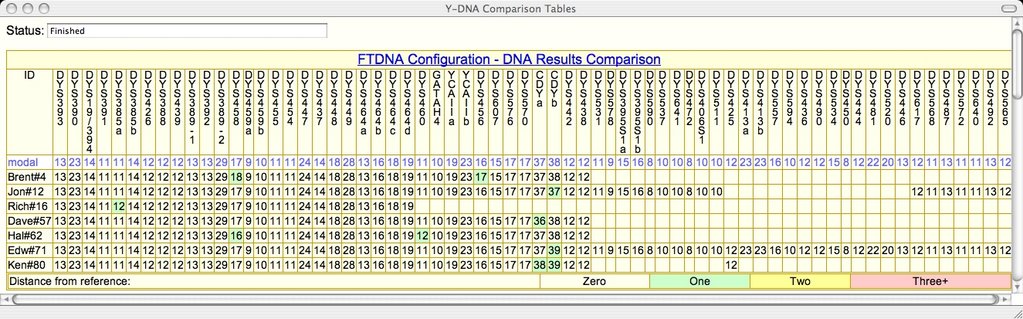
And I promised a cladogram of the Culpeper Co. Berrys 37 marker folks, so I also did some distances and an MRCA table.

Here are their haplotypes -
and here's their cladogram -
Now I'm no expert on reading these things but take a look at their male ancestries, here -and see if it doesn't look to you that if they could find the person that belongs out there where that 'mv1' is on the cladogram, they would have found a very important common ancestor who would tie this whole family together.

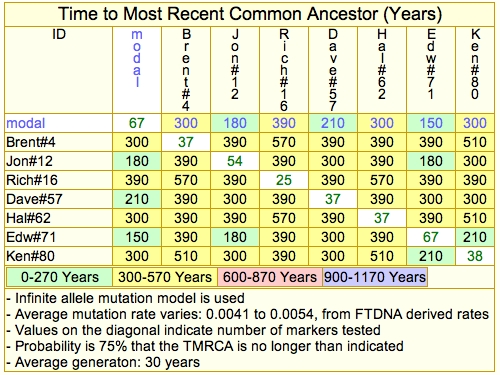
So here's a chart that might tell with a 75% probability about how far back they should expect to find that common ancestor -
And here are their genetic distances -I don't really see any recLOH events here that could impact these distances, but Ken's CDY mutation should be counted as a '1' under our 'Non-recLOH Event Multi-copy Marker Distance Counting Protocol' and the distance table would look like this.

Friday, November 24, 2006

Thanks

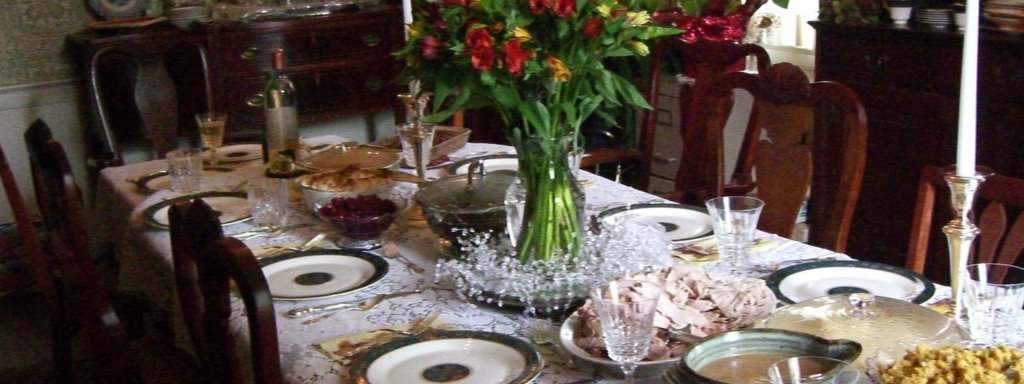
Hope yours was as good . . . .


 . . . . need I say more?

Thursday, November 23, 2006

The drought is broken!

At long last!   A few results . . .

Not many.   Only two.   Kenneth, #80, a week or so early, and Michael, #38, right on time.   In the meanwhile, the half dozen tardy tests are more tardy.   Not to mention the two Deep SNP tests that are so tardy I won't mention them.

Michael's YDNA26-37 markers came in, the last of his upgrade, and he still doesn't match anyone.   Michael's closest participant is a genetic distance of ten at 37 markers.   Someone will come along.

Kenneth's markers were also YDNA26-37 but were only another segment of his 67 marker order.   The balance are due November 29 but good luck on that if the experience of our six others is any guide.

Actually, Kenneth is a Culpeper Co. Berry, coded aqua and that family is developing some interesting differences that might be quite helpful.   Of its seven members, six have now tested to 37 markers.   We'll have to see what a cladogram might reveal.

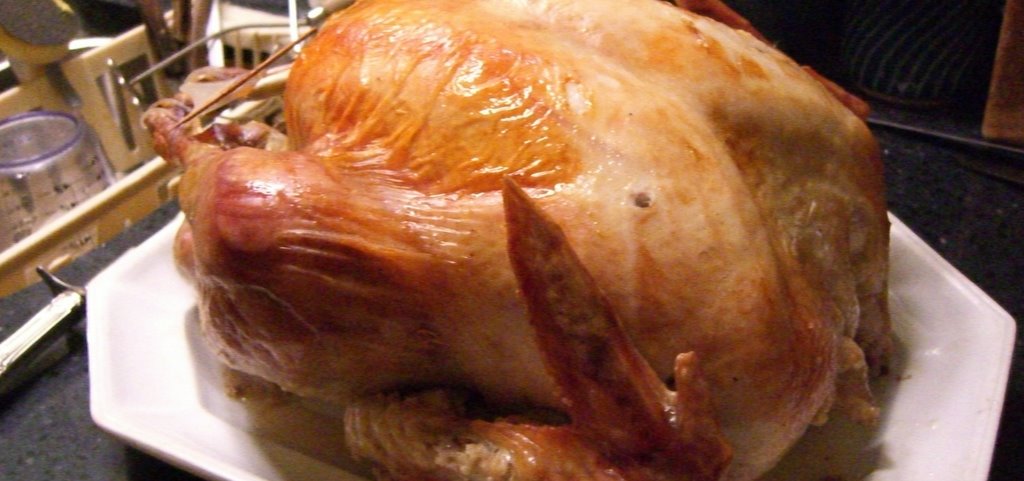
But, that'll have to be another day.   Now, I'm off to cook the turkey.

Wednesday, November 22, 2006

Here's the skinny -

After several emails with John McEwan I now believe I mostly understand what he is trying to tell me.   Fortunately, he's a very patient man.

Apparently, because of the way FTDNA and others report multi-copy markers, what appear to be recLOH events may not really be.   They may, in fact, actually be deletions.   In order to be as nearly correct as possible, however, I should say that both are recombination events, one, called recLOH, a gene conversion where one copy is overwritten by the other copy, and the other actual gene deletions.

Fortunately, for most of us that won't make any difference because all we're interested in is being able to count genetic distances in order to determine relatedness and, again fortunately, both are treated the same for that purpose.

Some of you, however, may be interested to actually know whether your 'apparent' recLOH markers are really gene conversions or deletions and John has told us how to discover that.   I'm going to quote from several of John's emails to me and so that you will be able to easily tell when someone who knows what he's talking about is speaking, I'll put his quotes in green.

For starters, he changed the language slightly of the longer paragraph of the Wikipedia article I began our recLOH page with to better conform to his belief:

When Y chromosome STR databases are searched for twin alleles at 3 or more duplicated markers on the same palindrome (hairpin), e.g., DYS459, DYS464 and DYS724 (CDY) on palindrome P1, then a higher than expected proportion of 9-9, 15-15-17-17, 36-36 combinations and similar twin allelic patterns will be found.   PCR typing technologies and new markers have been developed (e.g. DYS464X and DYF399) that are able to distinguish that these results are a combination of gene conversion or RecLOH events and deletions caused by unequal recombination.   The true rates of both processes are not known, but for the P1/P2 palindrome where deletions and gene conversions can usually now be distinguished the deletions are more prevalent.   The frequency of these events has not been well estimated, but appears to be intermediate between the mutation rate of STRs (~1E-4) and SNPs (~1E-8).   However, the outcome is the same:  what appear to be 3 separate, often multi-step mutations in different markers is in fact one single event.   So a 9-10, 15-16-17-17, 36-38 haplotype can change in one recombination event to the one mentioned above, because all three markers (DYS459, DYS464 and DYS724) are affected by one and the same mutation.   Appropriate allowance for this must be made when comparing individuals at these markers.   Genetic distance calculations commonly used for single copy markers may not be appropriate.   -and I have likewise so amended our recLOH page.

Summarized, For the P1/P2 deletions it is simple, you test with the palindrome pack and the deletions as distinct from gene conversions will be obvious because of the results at DYF371, DYF385, DYF397, DYF399, DYS725 and DYF408 where there will be MISSING alleles.

. . . DYS385a,b can be I think sorted out using the Kittler test (it can sort the alleles) and I think these mostly are real RecLOH events.

We might need someone to help us interpret them, but all the tests mentioned, including DYS464X, are available from FTDNA through their Advanced Orders section in their Panel 5 Palindromic Pack and their Kittler panel.

Tuesday, November 21, 2006

Do we care?

Sorry about not having anything of substance to post.   I'm in conversations with John McEwan about whether some or many of what appear to be recLOH events because of the way FTDNA reports them are actually partial deletions, how you can tell and whether it makes any difference if we're only interested in 'genetic distance'.   Stay tuned.

Sunday, November 19, 2006

Berry DNA Project website update

Well, I've added a new recLOH page to the Analysis section of the Project website on which I have gathered, compiled and hopefully clarified the three recent posts concerning the recognition of a recLOH event, its effect on genetic distances and, in addition, a methodology for counting genetic distances between non-recLOH multi-copy markers.

This suggested method is not universally accepted.   Ann Turner is not comfortable applying this method to DYS385 differences and John McEwan points out that the majority of "RecLOH" events in P1/P2 are NOT gene conversions as RecLOH is defined and as seems to have been suggested by the articles, but are instead deletions, i.e., RecNulls or RecDELs.

Nevertheless, and especially given the prevailing uncertainty as to the 'correct' or most accurate method, I believe that I will suggest that we use this model until we are shown why we should do otherwise.   Simply stated, it is that if it's a recLOH event we have a distance of one for the whole event (all multi-copy markers on a given palindromic arm) and if it's not a recLOH event we will count each multi-copy marker as a unit, not each part of the marker separately.

If this protocol has a bias, it's a bias toward 'relatedness'.

Saturday, November 18, 2006

The Non-recLOH Event Multi-copy Marker Distance Counting Protocol

Has a nice ring to it, doesn't it?

We have just considered recLOH events in which the multi-copy markers on a palindromic arm can all change significantly and only result in a genetic distance of one.   Pending authoritative directions otherwise I have determined how I will advise the members of this surname project to count genetic distances for differences in multi-copy markers that are not part of a recLOH event.   Multi-copy markers are those markers that have a small letter of the alphabet associated with them, i.e., DYS385a & b, DYS459a & b, DYS464a,b,c & d, CDYa & b, and YCAiia & b.

Consider that each of these markers is made up of two or more 'parts', each part represented by a value, e.g., DYS385a is 11 and DYS385b is 14, so we will designate DYS385 as 11-14, the two 'parts' being 11 and 14.   If either part changed to another value, no matter what value, it would be a mismatch of one 'part' and therefore a distance of one.   So 11-15 would be a distance of one from our example.  11-17 or 13-14 would likewise each be a change of one part from 11-14 and a distance of one.   12-13 or 13-15, however, would each be a mismatch of both (2) parts and a distance of two.   This illustration will apply to any of the two part markers.

The other case is DYS464 which is a four (or more) part marker.   The numbers for it are reported in lowest to highest format which is not necessarily their actual order.   So for DYS464 we have to determine how many markers the two people do not have in common.   Assume DYS464 is 14-14-16-18.   We want to know the genetic distance of 14-16-18-18.   Both have a 14, 16 and 18 in the series -- although not in the same positions -- position doesn't matter on this marker.   So 3 of the 4 numbers are the same, a 1 step mismatch, ergo a distance of one.   12-14-15-16, on the other hand, only has two markers in common, 14 and 16, so we have a two part mismatch or a distance of two.

Come to think of it, I have never seen the values of any multi-part markers reported in anything other than low to high format, no matter how many values.   That being the case I'll go out on a limb just a little and suggest that if we have a two part marker like CDY as 35-39 and we want to compare another marker of 39-40 with it, the distance should be one since we have a mismatch of only one value.

That's the way I see it.

ADDENDUM:  POSTED AT 2:40 PM
Ann Turner, co-author of "Trace Your Roots with DNA:  Using Genetic Tests to Explore Your Family Tree" does not feel comfortable applying this method for my examples of DYS385 changes.   She says:
I think we need to wait for FTDNA to revise its algorithm, as used on YSearch as well as the adminstrator's page.   In the meantime, here's how I would count the changes in a situation where 11-14 is the ancestral haplotype:
11-15 one step
12-14 one step
11-11 one step due to recLOH (the 11 overwrites the 14)
14-14 one step due to recLOH (the 14 overwrites the 11)
11-16 two one-step changes, with a lower probability of one two-step change
11-17 a judgment call:  if the remainder of the markers are in line with the ancestral haplotype, then this could be a one-time sudden jump, a rare event (more like a SNP than an STR in terms of mutation rates).   However, it would also be unusual to have three one-step jumps (or a two and a one) all occuring on one marker in a single line of descent, and I don't know which scenario is more likely.   Father/son studies show that about 96% of mutations are one-step.
My conclusion:  Take your choice.

Thursday, November 16, 2006

recLOH, cont.

It seems to my uneducated eye that we have (at least) two questions here:  One, how to recognize and count a recLOH event and, two, how to count multi-copy marker differences, whether a part of a recLOH event or not.

We are told that recLOH events must occur within a palindromic arm.   So what's a palindrome?

From Wikipedia -
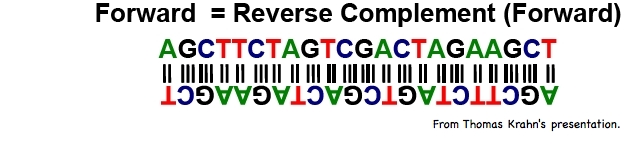
"In most genomes or sets of genetic instructions, palindromic motifs are found.   However, the meaning of palindrome in the context of genetics is slightly different to the definition used for words and sentences.   Since the DNA is formed by two paired strands of nucleotides, and the nucleotides always pair in the same way (Adenine (A) with Thymine (T), Cytosine (C) with Guanine (G)), a (single-stranded) sequence of DNA is said to be a palindrome if it is equal to its complementary sequence read backwards.   For example, the sequence ACCTAGGT is palindromic because its complement is TGGATCCA, which is equal to the original sequence in reverse."

"A palindromic DNA sequence can form a hairpin. Palindromic motifs are made by the order of the nucleotides that specify the complex chemicals (proteins) which, as a result of those genetic instructions, the cell is to produce.  . . . .  Recently a research genome sequencing project discovered that many of the bases on the Y chromosome are arranged as palindromes."

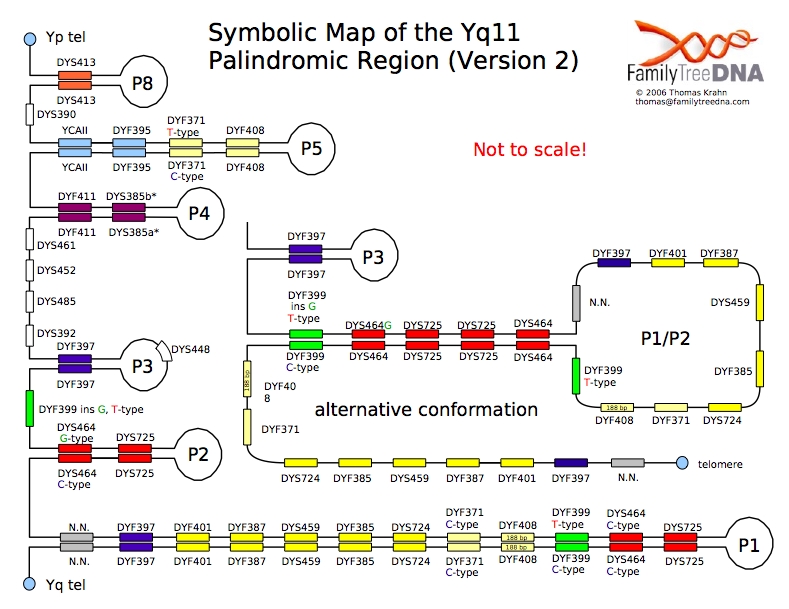
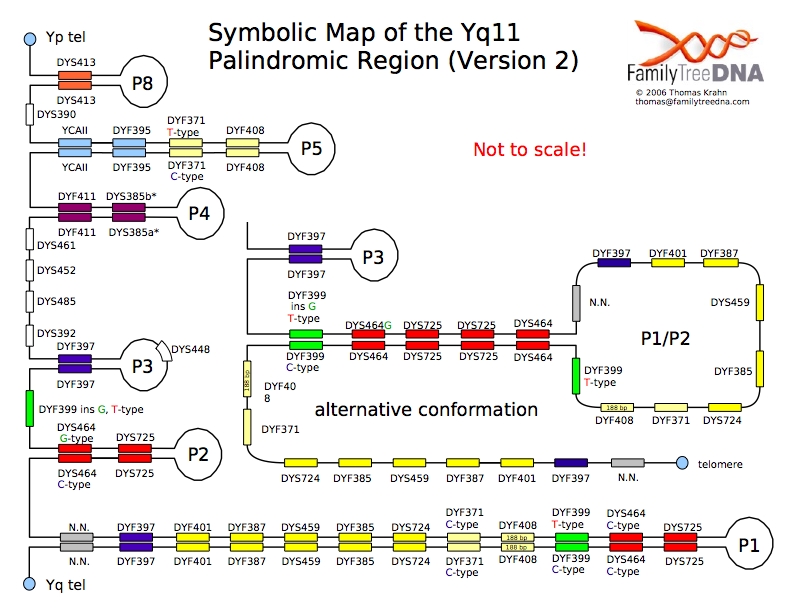
As illustrated by Thomas Krahn's diagram-"A palindrome structure allows the Y chromosome to repair itself by bending over at the middle if one side is damaged."

My understanding is that this repair is the 'recLOH event'.   How then do we recognize it?

Recall from our previous lesson that our multi-copy markers (at least the only ones I know about) are DYS459, DYS464 and DYS724 (CDY) located on palindrome P1, DYS385 on palindrome P4 and YCAii on palindrome P5, and that within any of those palindromic arms the marker numbers "will be identical in a recLOH event"?   So look for duplicated markers in those mentioned.   For example,  9-9,  15-15-17-17,  36-36  for DYS459, DYS464 and DYS724, respectively.   That would indicate one recLOH event and, no matter what their values were before, a distance count of only 1.

Using Adrian's example, again from our previous lesson-
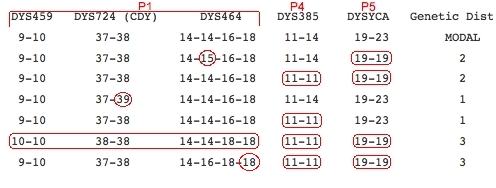
the circles represent mutations and the oblong circles represent recLOH events.

However, assume we're starting with a   9-10,  15-16-17-17,  36-38  haplotype.   A 9-10,  15-15-17-17,  36-38 haplotype would not be a recLOH event, nor would a  10-10,  15-16-17-17,  36-38  haplotype nor a  9-10,  15-16-17-17,  36-36   haplotype, and, except for multi-copy marker counting peculiarities which we will consider later, would be counted in the usual manner.   We should be suspicious, however, of e.g., a  10-10,  15-16-17-17,  36-36  haplotype which, by the principle of Occam's razor would be a distance of  2, i.e., a recLOH event followed by a simple mutation.

At least, that's my understanding of it.   Please, whoever knows otherwise, let me know my mistakes so I can correct them here.

We will consider how to count multi-copy marker differences not a part of a recLOH event later.

Wednesday, November 15, 2006

farewell

Sorry, but this is so good that I can't resist.   For those of you who don't like my expression of 'political' views, this would be the place to stop and come back tomorrow.

For the rest of you - here's one minute and 20 seconds of incisive political humor.


...and for those of you contemplating retirement, there are other choices to occupy your time than just becoming a DNA-hobbiest, for example, look at John Ivers:

Tuesday, November 14, 2006

New member

We have a new member, Robyn Berry Halverson, who tested her HVR1 region through the Genographic Project.   Robyn is mt haplogroup H, 16519C, and is our 85th member.

Speaking of new members  -  we need some!   Our last new member joined us September 25th, also from the Genographic project.   Surely you all have someone you'd like to urge to test, or sponsor, to help confirm some lines or clear up some questions or discrepancies in your paper trails.

Monday, November 13, 2006

recLOH

Recombinational loss of heterozygosity has been a big topic of discussion on the DNA lists recently where folks are attempting to understand its effect on genetic distances as genetic distance is a measure of 'relatedness'.   I'm having a great deal of difficulty with not only the concept but also coming to an understanding of just what occurs during the recLOH process.   I've attempted to gather some materials so that perhaps some of you might be able to grasp the concept and explain it to the rest of us.

From Wikipedia:

"RecLOH is a term in genetics that is an abbreviation for "Recombinational Loss of Heterozygosity".

This is a type of mutation which occurs with DNA during recombination.   From a pair of equivalent ("homologous"), but slightly different genes, a pair of identical genes results.   In this case there is a reciprocal exchange of genetic code.

In genetic genealogy, the term is used particularly concerning similar seeming events in Y chromosome DNA.   This type of mutation happens within one chromosome, and does not involve a reciprocal transfer.   Rather, one homologous segment "writes over" the other.   The mechanism is presumed to be different from RecLOH events in autosomal chromosomes and probably like gene conversion, as it has been witnessed in bread mold.

During the mutation one of these copies overwrites the other.   Thus the differences between the two are lost.   Because differences are lost, heterozygosity is lost.

Recombination on the Y chromosome does not only take place during meiosis, but virtually at every mitosis when the Y chromosome condenses.   Recombination frequency even exceeds the frame shift mutation frequency (slipped strand mispairing) of (average fast) Y-STRs, however many recombination products may lead to infertile germ cells and "daughter out".

Recombination events (RecLOH) can be observed if YSTR databases are searched for twin alleles at 3 or more duplicated markers on the same palindrome (hairpin).   E.g. DYS459, DYS464 and DYS724 (CDY) are located on the same palindrome P1.   A high proportion of 9-9, 15-15-17-17, 36-36 combinations and similar twin allelic patterns will be found.   PCR typing technologies have been developed (e.g. DYS464X) that are able to verify that there are most frequently really two alleles of each, so we can be sure that there is no gene deletion.    Family genealogies have proven many times, that parallel changes on all markers located on the same palindrome are frequently observed and the result of those changes are always twin alleles.   So a 9-10, 15-16-17-17, 36-38 haplotype can change in one recombination event to the one mentioned above, because all three markers (DYS459, DYS464 and DYS724) are affected by one and the same recLOH event."

The ISOGG glossary explains recLOH as "When a section of DNA on a marker is missing, that marker is sometimes repaired by another marker filling in the missing DNA with its own material.   This is referred to as a "recLOH event" and is usually observed with multi-copy markers like 385a and 385b, and is also common in the 464 set.   The recLOH event causes the allele values to match 11-11 instead of the more common, 11-14 that you see in R1b."

A discussion of DYS464 by John McEwan that touches on recLOH.

Here's Thomas Krahn's explanation.

Thomas' diagrams...

Below from Adrian Williams from yesterday's DNA list...

Y'all,

I have been able to talk with Bennett a few times this week and he helped clear the air (and my head).   Hopefully this will clarify the information and measuring genetic distance on the palindromic markers.

Yes, measuring the recLOH is with each palindromic arm.   For example, DYS385 is on P4 while DYS459, DYS464 and CDY (DYS724) are on P1 and YCAii is on P5.    From the information from the conference that ALL lettered markers are affected (i.e. suffixed with a letter a, b, c, etc).

And you are also correct that the recLOH is very specific...in other words, according to Bennett, the numbers will be identical in a recLOH event.   For example, on 385 a person with  11  11  and another with  11  14.   A recLOH has most likely occurred here with the  11  14  being the ancestral value and the  11  11  being the newly recombined value, the genetic distance being  1.    And, when I asked about a non-identical move, for example two CDY values:  37  38  and  37  39,  these do not constitute an recLOH event and is simply a mutation.

Additionally, both Bennett and Thomas indicate that all mismatches on a given palindromic arm that are caused by a recLOH are counted as one.

So, this is my understanding of the way we count the mismatches on palindromic markers:

Given these results (from Thomas' presentation at the conference) of markers that all occur on the same palindromic arm:

DYS459 DYS724 (CDY) DYS464 Genetic Distance
9-10 37-38 14-14-16-18 MODAL
9-10 37-38 14-15-16-18 1
9-10 37-38 14-14-16-18 0
9-10 37-39 14-14-16-18 1
9-10 37-38 14-14-16-18 0
10-10 38-38 14-14-18-18 1
9-10 37-38 14-16-18-18 1

In this example, Thomas has clearly indicated that a multi-marker recLOH on that same palindromic arm constitutes a 1-step mutation.   So, instead of the last results set being 3 steps from the modal, it is only 1, the mindset being that the repair event occurred along all portions of that particular palindromic arm.

And you can very well have an event on one arm and not the others, which makes our mismatch determinations even more fun!

Now, using the same set and adding the other palindromic markers, you can see, each arm is counted independently.

DYS459 DYS724 (CDY) DYS464 DYS385 DYSYCA Genetic Distance
9-10 37-38 14-14-16-18 11-14 19-23 MODAL
9-10 37-38 14-15-16-18 11-14 19-19 2
9-10 37-38 14-14-16-18 11-11 19-19 2
9-10 37-39 14-14-16-18 11-14 19-23 1
9-10 37-38 14-14-16-18 11-11 19-23 1
10-10 38-38 14-14-18-18 11-11 19-19 3
9-10 37-38 14-16-18-18 11-11 19-19 3

I hope this clears my earlier confusion.   There is some additional information about DYS464 and how it can exist on two different arms, but that is another discussion for another day.   If someone can help clarify and/or correct this, I know I for one will be grateful as I was still in the "oh crap!" mindset when some of this was being explained during Thomas' presentation.

Kind regards,
Adrian

With this addition from Vincent Vizachero...

I would only add the following, based on my recollection and understanding:

1. There are two possible configurations of P1 and P2.   They can exist separately or combine into a single palindrome arm (P1/P2), thereby raising the number of possible solutions.

2. Palindromic regions do not always manifest as palindromic arms, which is one reason that sometimes you can get a RecLOH and sometimes just normal mutations.

3. The parsimony principle dictates that you establish the minimal number of steps that can explain your results.   For example a mutation at DYS385 from 11,15 to 11,12 should be counted as a GD of 2, not 3.   The most parsimonious explanation is a RecLOH (the 15 became 11) followed by a normal mutation (one of the 11s became a 12).

Vince

If you think that you're really up for it, here's the link to Thomas Krahn's Presentation on palindromic markers at the recent FTDNA sponsored International DNA Genealogy Conference in Houston 2006, the basis for the bulk of this discussion.   Or, here's an alternate link.

Click here for lesson two.

Sunday, November 12, 2006

Time on my hands

Nothing DNA going on  -  time on my hands  -  imagination runs amok!   Enjoy!


If there's again no DNA activity today, lab or otherwise, to report to you tomorrow, tomorrow's subject will be recombinational loss of heterozygosity!

Saturday, November 11, 2006

brown again

Yesterday we received Y-DNA61-67 Markers, again they were for C.E. Berry, #77 and William A. Barry, #79, both Barry/Berrys, coded brown.   This makes a total of 54 markers they have had reported, all exactly alike  --  zero genetic distance.   Just what does this mean?   That is the question, isn't it?   Hopefully, some more record genealogy work will give us the answer.   All we know to this point is that they are very closely related.

With the return of these two sets of markers, ALL the remaining tardy markers are YDNA48-60!
 Kit         Name          Batch    EstResultDate 
26075 Walter,#34 167 10/09/2006
15097 Jonathan,#12 168 10/16/2006
50372 John E.,#55 168 10/16/2006
67364 Todd,#72 169 10/23/2006
69605 C. E.,#77 170 10/30/2006
N8296 William A.,#79 170 10/30/2006
Maybe they'll all come in together?

We cannot let this Veterans Day pass without reckoning the cost of "W"'s War.

Since we invaded Iraq on March 20, 2003:
      2,842 U.S. service members killed.

21,485 U.S. service members wounded.

- Iraqi civilian deaths estimated at between 46,915 and 52,021
Click here to Think Peace

Friday, November 10, 2006

purple, blue and brown

William Martin Berry's, #73, DSNP-R1b test has been returned and he is R1b1c based on these results:  M207+ M173+ M343+ P25+ M269+ M18- M73- M37- M65- M126- M153- M160- SRY2627- M222- P66-.   These results have been posted and, as a reminder, may be accessed by clicking on his haplogroup on either of the yResults pages, or here.

In addition, Y-DNA61-67 markers, the balance of their 67 marker orders, have been received for jim berry, #7, and Charles Redmon Berry, #27, both Augusta/Washington Berrys, coded purple, and for Walter Michael Berry, #34, a Berry Plain Berry, coded blue.

Plus, Y-DNA38-47 Markers for C.E. Berry, #77 and William A. Barry, #79, both Barry/Berrys, coded brown.   This is a puzzle!!   At 37 markers FTDNA says that the likelihood they shared a common ancestor within 6 generations is 93.29%.    They've just added 12 more identical markers so you'd think they must be really close??   The problem is that C.E.'s paper trail goes back nine generations to the 1670s in Virginia, while Bill's paper trail only goes back five generations to 1849 in Ireland with emigration to this country in 1850!?!?   What's going on here?

Thursday, November 09, 2006

Better late than never

Sorry, I'm a little tardy in getting this post up but I was busy selling some law books I had listed on Craig's list.

New results are in for James Dennis Berry, #28, and Jonathan K. Berry, #12.   Y-DNA48-60 markers arrived for Dennis mid-afternoon yesterday completing his 67 markers and are now posted to the Project website.   Dennis is the 4th Project member to have received his full 67 marker results.   His order was in batch 166 and was completed 37 days late.

Y-DNA26-37 markers arrived for Jonathan a little later in the afternoon, another installment on his 67 marker upgrade, likewise posted to the website.   These markers were part of batch 168 and are only 21 days late.   Jonathan still has markers 48-60 unreported.   At 37 markers Jonathan is a distance of 2 from David, #57, and Edward, #71, and a distance of 3 from Brent, #4, and Harold, #62, all Culpeper Co. Berrys, coded aqua.

I believe that I will institute a new procedure related to these upgrade orders.   In the past I have tried to remind you to upload your new markers to YSearch with varying degrees of success.   I think that beginning with these markers and for future upgrades, if you have already uploaded your original markers to YSearch I am going to assume that you would also want these additional markers uploaded and will just do it for you.   Seems to me that that will be a lot simpler and will still be in accordance with your wishes.   Please let me know if anyone disagrees.

Woops!  Well, maybe not.   It seems that I'd need your password to do that.   Rats!   It seemed like such a good idea.   If anyone can think of a way around that impediment, let me know and we'll see if it would work.   But, in the meantime, I'll continue to remind Dennis and Jonathan and anyone else who has uploaded your markers to YSearch and have since gotten additional results:  Please check into your 'My FTDNA' page through the FTDNA website, click on the 'Y-DNA Matches' tab and then click on 'Click here to upload the additional markers to Ysearch.org' which you will see in a box just above the matches themselves.   You will then be asked for your YSearch password to complete the upload.   If you have already uploaded all your results you will not find the box I just described.

During the recent 3rd annual Family Tree DNA genetic Genealogy Conference FTDNA announced that if they could not predict your Haplogroup with 100% confidence, they would run your DNA sample through their Back Bone SNP test for free.   Read about the new FTDNA SNP Assurance Program here.

Almost an afterthought  -  but theirs rather than mine.   Overnight we also recieved the Y-DNA26-37 marker results for D.F. Berry, #76, which completes his 37 marker order.   D.F. is a member of the Benton Co. Berrys, coded gold.   I'll have his results posted shortly.

Wednesday, November 08, 2006

Thank you

Thanks for voting.   You did good.

Tuesday, November 07, 2006

election day

Michael James Berry, #38, received his Y-DNA13-25 markers from his batch 173 Y-DNA37 order yesterday.   Those markers were not expected until Nov. 22.   FTDNA seems to be running through the more established markers early while remaining tardy on their newer offerings.   We still have markers past due in batches 166, 167, 168, 169 and 170, all due in October (not to mention the past-due SNP tests from batches 144 and 149).   I had thought I was going to have a busy October posting results, but that seems to have slipped to (hopefully) November.

Actually, it has been several weeks since I've posted an update of outstanding and past due orders for Project members.   So here's one.
Kit      
Product Test Name Batch EstResultDate
13030
Y-Refine37to67 Y-DNA61-67 Markers Jim,#7 167 10/09/2006
DYS434 DYS434 174 11/27/2006
DYS435 DYS435 174 11/27/2006
DYS485 DYS485 174 11/27/2006
DYS495 DYS495 174 11/27/2006
DYS643 DYS643 174 11/27/2006
15097
Y-Refine25to67 Y-DNA48-60 Markers Jonathan,#12 168 10/16/2006
Y-DNA26-37 Markers 168 10/18/2006
22287
Y-Refine37to67 Y-DNA61-67 Markers Charles,#27 167 10/09/2006
22442
Y-Refine25to67 Y-DNA48-60 Markers James D.,#28 166 10/02/2006
26075
Y-Refine25to67 Y-DNA48-60 Markers Walter,#34 167 10/09/2006
Y-DNA61-67 Markers 167 10/09/2006
32218
Y-Refine12to37 Y-DNA26-37 Markers Michael J.,#38 173 11/22/2006
37201
DeepSNP-R1b DSNP-R1b Brian JL,#49 149 06/09/2006
50278
DeepSNP-R1b DSNP-R1b Keith,#54 144 05/01/2006
50372
Y-Refine37to67 Y-DNA48-60 Markers John E.,#55 168 10/16/2006
67364
Y-Refine37to67 Y-DNA48-60 Markers Todd,#72 169 10/23/2006
67852
DeepSNP-R1b DSNP-R1b William, #73 173 11/20/2006
69574
Y-DNA37 Y-DNA26-37 Markers D. F.,#76 171 11/17/2006
69605
Y-Refine37to67 Y-DNA38-47 Markers C. E.,#77 170 10/30/2006
Y-DNA48-60 Markers 170 10/30/2006
Y-DNA61-67 Markers 170 10/30/2006
73459
Y-DNA67 Y-DNA38-47 Markers Kenneth, #80 173 11/29/2006
Y-DNA48-60 Markers 173 11/29/2006
Y-DNA61-67 Markers 173 11/29/2006
Y-DNA26-37 Markers 173 12/01/2006
N8296
Y-Refine37to67 Y-DNA38-47 Markers William A.,#79 170 10/30/2006
Y-DNA48-60 Markers 170 10/30/2006
Y-DNA61-67 Markers 170 10/30/2006
As you see, we still have several orders a little past due, the Deep SNP orders quite badly past due.

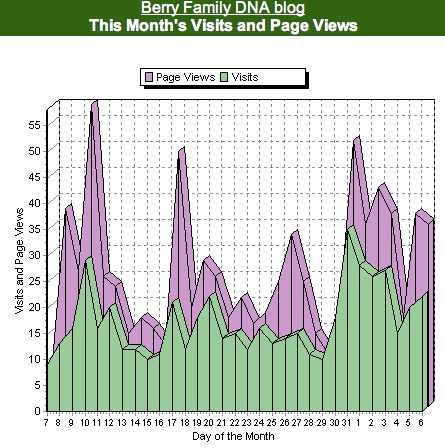
Plus a report on blog usage this past month:


VOTE!

Monday, November 06, 2006

Black Days

Photo courtesy The Memory Hole.

This is adding injury to injury.

2,973 people died in the terrorist attacks of September 11, 2001.

Since we invaded Iraq on March 20, 2003

2,836 U.S. service members have been killed in

"W"'s War.
Click here to Think Peace

VOTE to save our Country.

Sunday, November 05, 2006

Culpeper Co. Berrys

Congratulations to Kenneth Ray Berry, #80, who just minutes ago had his Y-DNA13-25 markers returned confirming his ancestry in the Culpeper Co. Berry family.   That group is doing well.   When the balance of Ken's 76 markers arrive and when Jonathan's, #12, 67 markers arrive (overdue), 6 of the 7 members of that family will have at least 37 markers to compare, and three will have 67.   That 37 marker cladogram ought to get real interesting.   Richard?

Friday, November 03, 2006

VOTE

Folks, we're in bad trouble and you've got to do something about it.

Our actions related to "W"'s War have tarnished our adherence to universal human rights.

We're thought of throughout the world as an aggressor nation.   We've taken over the place in the world occupied by the Soviet Union in the 1950s, 60s, 70s and 80s.   We've lost the moral high ground and the irony is that we've lost it because of the Christian Right and a President who believes he's on a mission from God.

Our government no longer has any checks and balances.   We have a maverick President intent on extending executive powers and a do-nothing Congress too occupied with protecting their own positions and power to spend any time protecting the country.

I began this post by saying that YOU have to do something about it.   I said that because I know that I'm going to VOTE and that I'm going to vote to do something about it -- I just don't know about you.


Wednesday, November 01, 2006

Augusta OTW

The plaza at night
Yes, it did
Breakfast
Programs in the Chapel


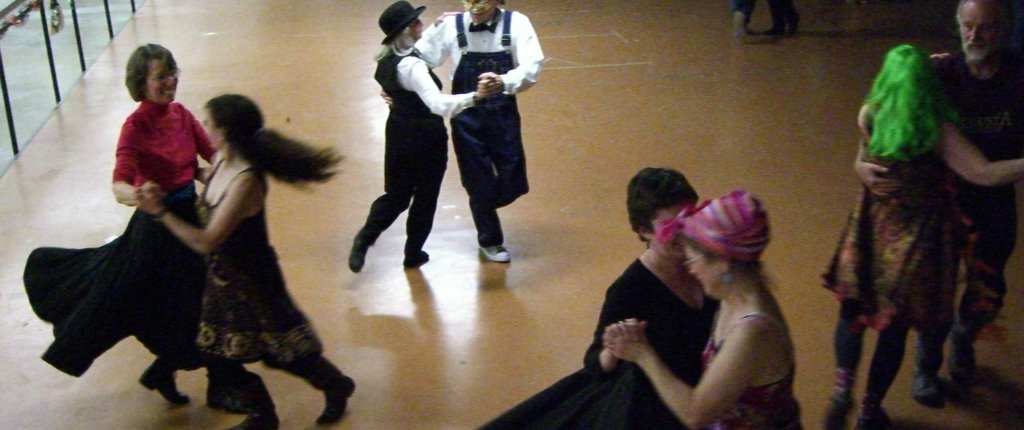
Halloween dance

Cakewalk winner
Hant dance caller
             

Jam in Hermanson and fiddler needs a chip -


Fiddlers Reunion


Chapel Hymn sing